words EMILY LUSH top image SARAH DORWEILER via UNSPLASH
Streaming a movie, sending an instant message or simply storing photos in the cloud – they’re the seemingly insignificant online actions most of us rely on for convenience and comfort.
But it’s easy to forget that each time we hit send, search or play we’re consuming energy, and that what we do online has real impacts in the offline world.
In 2020, greenhouse gas emissions associated with the tech sector peaked at 1.7 billion tonnes or an estimated 1.8–3.2% of global contributions. The BBC recently reported that emissions from our gadgets and internet infrastructure combined are similar to those produced by the aviation industry – a figure that’s expected to double by 2025 – while research out of Australia reveals that the average internet user is responsible for the equivalent of 81kg of CO2 emissions every year.
It’s easy to forget that each time we hit send, search or play we’re consuming energy, and that what we do online has real impacts in the offline world.
As more and more of us start to consider the link between our digital footprint and carbon footprint, a new suite of tools and services has emerged to help us monitor and offset our impact. Some tech innovations even harness our online habits to help us proactively contribute to a better world.
A more sustainable online presence is just a few clicks away. Here are seven tech alternatives you can start using today.
WaterBear
How many times have you watched an inspiring documentary and felt compelled to act only to forget about it the following day? Dubbed ‘the Netflix for nature’, WaterBear is a new online streaming service that makes it easier than ever to go from armchair activist to changemaker.
The platform launched in December 2020 and already has a library of hundreds of nature, climate and community-focused documentaries, all completely free to watch when you sign up. More than 80 organisations including WWF, Greenpeace and the Jane Goodall Institute have already put their weight behind the platform. After you’ve streamed a flick, WaterBear connects you directly with NGOs working on the issue at hand so that you can donate, volunteer, sign a petition or simply create awareness by sharing the message with your network.
Ethical Mail
According to the Carbon Literacy Project, sending a standard email emits 4 grams of CO2e (carbon dioxide equivalent) on average. Attach a photo, and that goes up to 50 grams.
Alternative email providers such as Sydney-based Ethical Mail make it straightforward to send a clean message. The company offsets all carbon emissions incurred through data storage and processing, uses local servers, and is completely ad-free to make the service more efficient.
Sending a standard email emits 4 grams of CO2e (carbon dioxide equivalent) on average. Attach a photo, and that goes up to 50 grams.
If you’re not up for switching providers, there are some easy steps you can take to reduce the impact of your online correspondence: reduce the size of your emails by compressing images; link to files online rather than sending large attachments; and unsubscribe from lists you no longer use.
If instant messaging is your communication tool of choice, check out Greenpeace’s #ClickClean campaign, which assesses popular messaging apps and grades them according to the percentage of clean energy they use.
Neutral
Online shopping has become a way of life for many of us, with digital purchases in Australia up a whopping 44.3% in January 2021 compared to the previous year.
While the jury’s still out on whether or not buying online is less carbon-intensive than shopping in-store, one thing’s for sure – digital purchases still have a carbon footprint, especially when it comes to shipping.
Tools such as Neutral, a browser plugin that’s free to download and use, are designed to help online shoppers make more informed decisions. It works by displaying the estimated carbon footprint of your shopping cart as you browse, and even gives you the option to offset your purchase with carbon credits when you pay. It’s currently only compatible with Amazon.
If you’re on the other side of the digital checkout counter, Shopify has an in-built tool that lets business owners automatically monitor and offset emissions from orders made on your website.
Ecosia
Pressing the search button and browsing the web may seem innocent enough, but considering Google alone handles more than 40,000 searches every second, there’s a huge potential for impact.
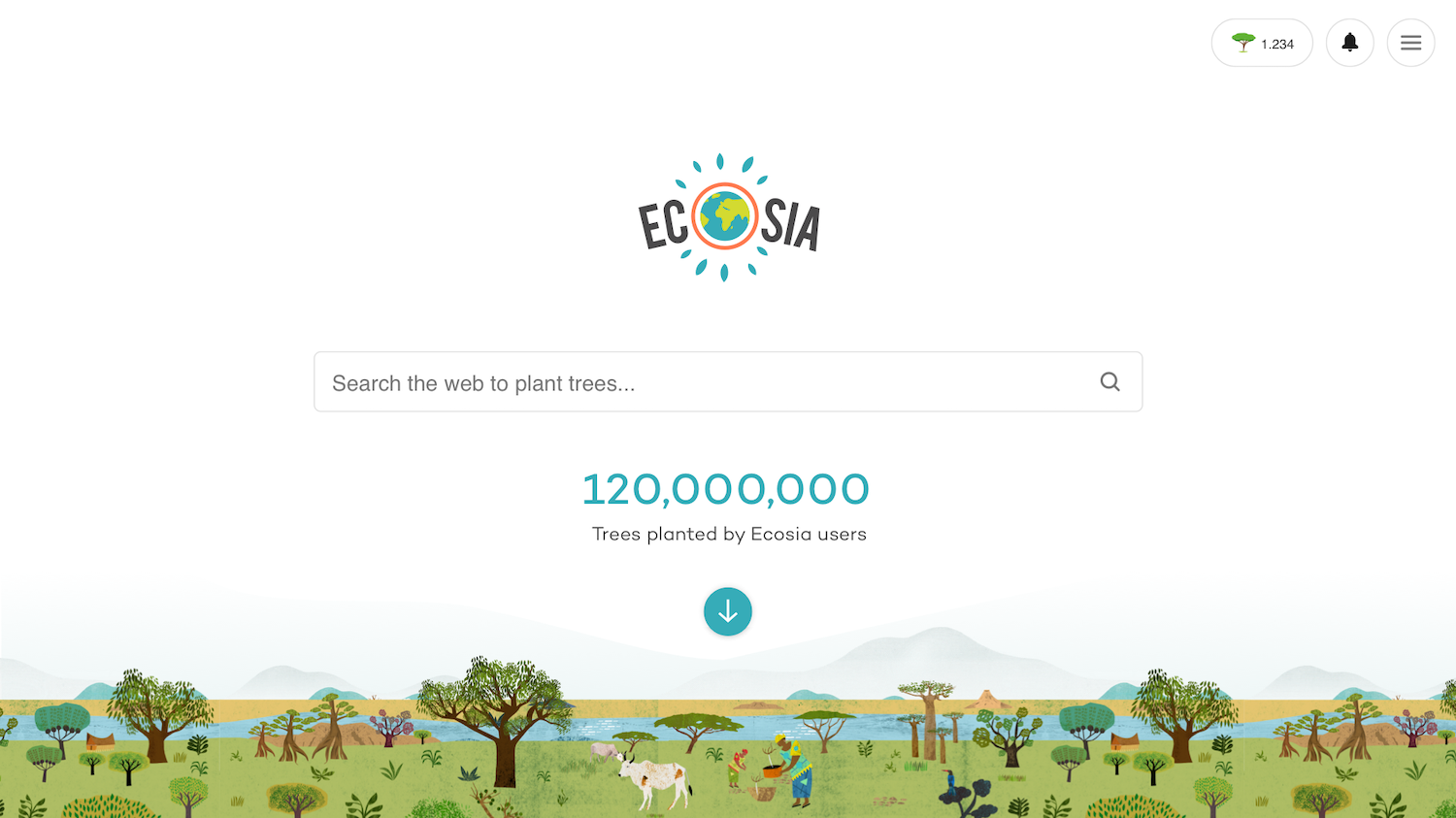
Ecosia channels the power of all those clicks to plant trees. It functions like any other search engine, only 80% of the B Lab-certified platform’s profits are donated to nonprofits that reforest the planet.
Since launching on the eve of the Copenhagen climate talks in 2009, Ecosia has invested over €12 million and helped plant more than 122 million trees in the Amazon Basin and beyond. On top of that, the platform is carbon negative, generating enough clean energy through its solar plants in Germany to ensure all searches are powered by 100% renewables.
TreeClicks
Similar to Ecosia, TreeClicks takes offsetting online orders a step further by planting a tree for every purchase you make. Better still, TreeClicks is compatible with more than 50,000 e-commerce websites (including eBay).
Activate the extension and every time you shop, the platform will absorb a small referral fee. This is donated to reforestation programs around the globe, including one to protect koala habitat in New South Wales. More than 2,600 trees have been planted since the launch in 2019.
DoneGood
Another handy browser extension you can set and forget, DoneGood is designed to help online shoppers make more sustainable and ethical choices at the checkout. The ‘shopping assistant’ analyses as you browse then automatically offers up suggestions for similar products from brands that are committed to people and the planet.
The B Corp-certified company behind the tech also offers its users discounts of up to 25% – a win all round.
Website Carbon Calculator
If you’re a business owner or entrepreneur with an online presence, there’s a good chance that your own website could be one of your most energy intensive online activities. Consider, for instance, that an average site produces 4.61 grams of CO2 for every page view.
Tools such as Website Carbon Calculator can help you measure your site’s footprint and identify areas to improve. Switching to an environmentally friendly host such as GreenGeeks can negate any impact by offsetting your emissions. This California-based company invests three times as much green energy back into the grid as it pulls out, ensuring its users do far more than just break even.