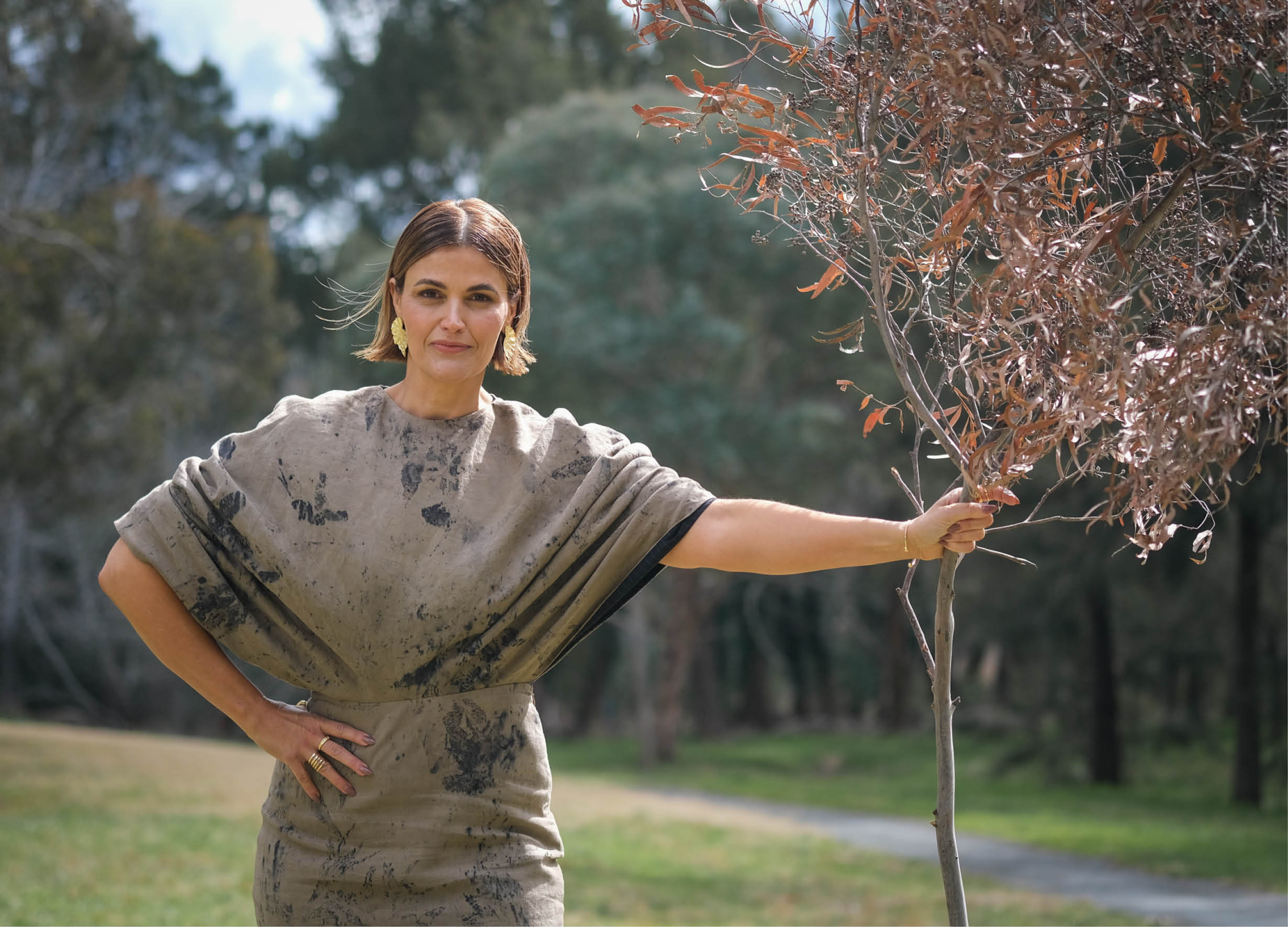
Frost wasn’t the only thing sparkling in Canberra this week! At the annual Midwinter Ball, Parliament traded policy papers for sequins and champagne – but one gown outshone them all. Environmental strategist Jo Taranto stepped out alongside her partner (Bennelong MP Jerome Laxale) literally wearing her values. Not borrowed from a runway, nor pulled from a boutique rack, her gown was a collaboration between Sydney designer Daisy-Rose Cooper (Soh Label), stylist, slow-fashion advocate and founder of Slogue, Joanne Gambale, and a circle of emerging sewists. Together, they transformed reclaimed antique French linen into a flowing ballgown, eco-printed with fallen eucalyptus leaves and dyed with historic fustic pigment (a natural yellow dye derived from the heartwood of the dyer’s mulberry tree).

For Jo, this dress was more than a showstopper – it was a conversation starter. Growing up on a fifth-generation farm in Tenterfield, NSW, she witnessed firsthand the devastation of drought in the 1990s. Today, her work takes her across the country helping business leaders find their climate courage. “Farmers, growers and industry know the climate is changing,” she explains. “This dress is intended to remind us that 2025 is a critical year; let’s make our nature laws as strong as possible.”
The fabric itself carries its own poignant story. The linen came from Joanne’s mother’s collection of antique French bed sheets, gathered from flea markets in southern France. Some of these monogrammed linens were over a century old, once part of trousseaus belonging to women whose fiancés never returned from the First World War. “They were late 19th, early 20th century, but good as new,” Joanne explains. “You don’t see cotton-linen like it anymore – the weight of it, the way it falls. Silk or wool would have been ideal, but I love to evangelise about limitations fostering creativity, and I’m so glad we had to use what we had at hand. I hope we’ve turned their sad history into something powerful and celebratory.”
I love to evangelise about limitations fostering creativity, and I’m so glad we had to use what we had at hand
This was Daisy-Rose’s first commissioned garment, and she describes the conceptualisation process as “collaborative and intentional”, ensuring the design reflected both Jo’s vision and Daisy-Rose’s approach to circular, process-driven design. “I believe objects made with intention bring meaning into daily life. Designing a custom fit rather than working off sample-size patterns was a rewarding technical challenge, requiring a new level of adaptability,” she says.
Daisy-Rose’s work is centered around material and process, embracing the unique qualities of natural fibres and the irregularities of plant-based dyeing. “The natural dye process is always both the most challenging and the most enjoyable aspect – it is unpredictable, and outcomes are shaped by the fibres and varieties of the native flora used. So that brought an element of risk that ultimately created the striking textures and depth that I love working with!”


Watching this dress come together was a deeply emotional process for Jo. “It’s more than fabric, it’s a piece of my story. I feel forever connected to it and have a newfound appreciation for the craftsmanship behind such a unique creation. And I’ll never forget the day of the final fitting: eight incredible women gathered to bring this dress to life. It transported me back to my grandmother’s sewing room as a child, reminding me of the magic that happens when women unite to create. That day, I knew we had crafted something truly special.”
It’s more than fabric, it’s a piece of my story.
Daisy-Rose understands this feeling of connection to a garment: “each piece becomes a reflection of its origin – its flora, pigments, and handmade nature – creating garments that are deeply connected to their materials and their makers, and using processes that are inherently sustainable, and rich with story.”
Fashion as a form of activism is nothing new. Think of suffragette colours, black armbands worn in protest, or even the simple act of rewearing an outfit in defiance of fast fashion. But in a world overflowing with throwaway trends, can ‘statement’ fashion still cut through the noise? Joanne thinks it can. “Fashion as activism could have the impact it needs if we can aggregate the many smaller statements already being made for a collectively bigger voice.”

And activism doesn’t always have to be a ballgown moment, either (although that’s pretty fab!). Joanne champions everyday gestures, too. “Mending is a big one,” she says. “Visible or not, it’s powerful. Supporting local slow or circular fashion makers is another. And yes, repeat wears, for special occasions. I wonder if Jo will wear this dress every year until the nature laws are adjusted? I’ll help her style it in lots of ways if she does!”
PHOTOS: Images of Jo by Linus Wong of LINUSTUDIO. Images of Daisy-Rose and the sewing circle by Chere Koh Photo.