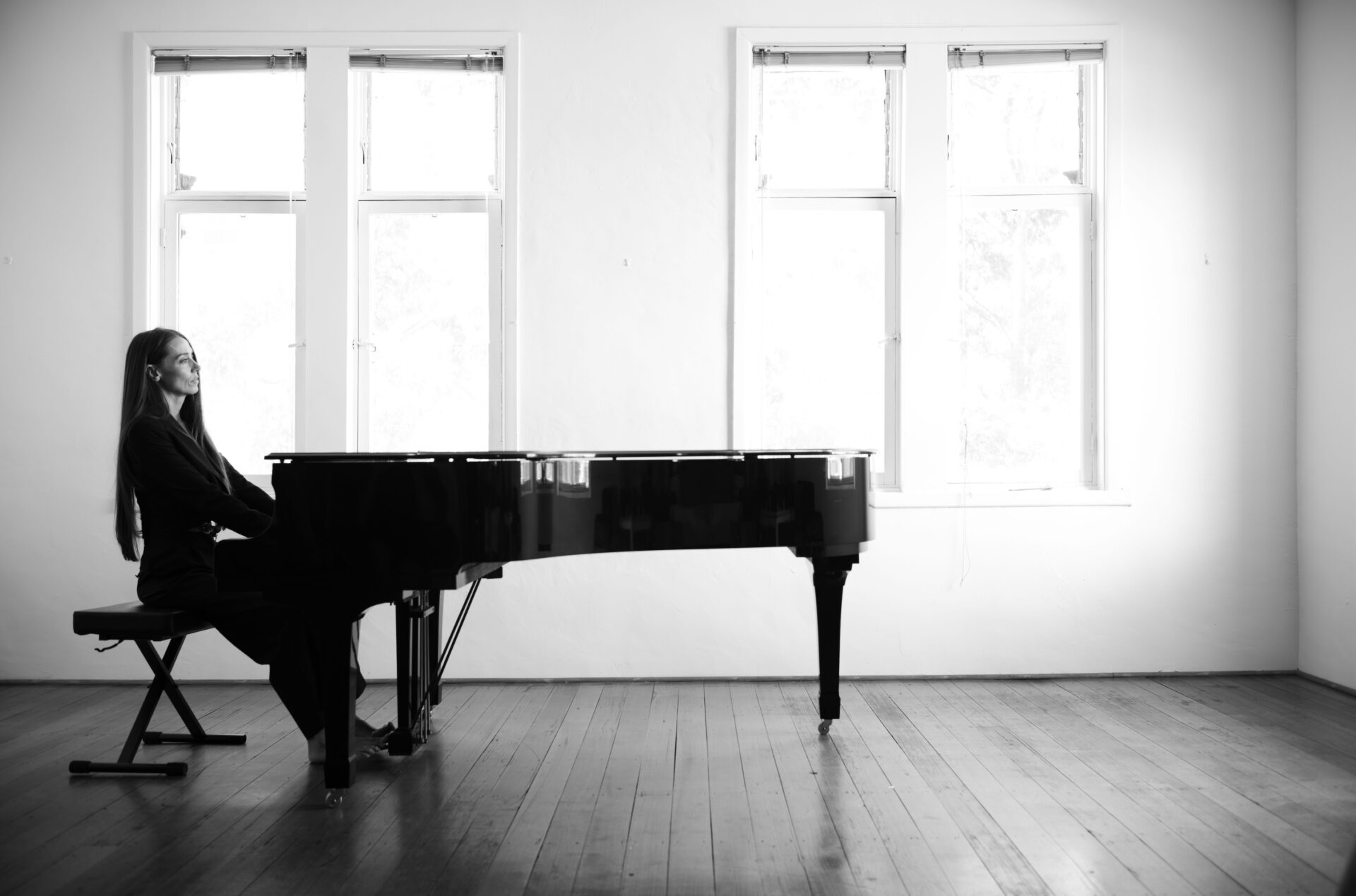
Some kinds of wisdom only arrive through transformation – the sort that comes from holding both an ending and a beginning in your hands at once. For pianist and composer Rose Riebl, this wisdom is woven into every note of her new album Dust, a work written in the space between her brother’s death and her daughter’s birth.
Due for release on November 14, Dust is Rose’s second album, and finds her expanding beyond her neoclassical roots, weaving guitar, drums, and ambient textures into her signature piano work. The result is an album that holds space for grief and joy to coexist, where silence becomes as meaningful as sound.
The album’s latest single, ‘Falling’ marks new territory for Rose: her first venture into lyric writing. Born from her score for Harley & Katya, an International Emmy-winning documentary tracing the story of figure-skating duo Harley Windsor and Katya Alexandrovskaya, the track builds from delicate piano motifs into something darker and more turbulent, featuring lines borrowed from Mahmoud Darwish’s poem Mural: “like when you named me / a storm on a wide sea”. It’s a song about longing, flight, fear, wonder, and love – the push-pull of hope and distress and growth.
We chatted to Rose to find out more about how she transforms life’s most seismic moments into sound.
PHOTOS: ALLI WOODS

Dust was written across a profound period – from your brother’s death to your daughter’s birth. How did you use your composing process to navigate these life-changing events? Was slowness, or perhaps a deliberate ‘taking your time’, part of this?
I didn’t set out to write an album bookmarked by these events, but they are the stuff of life, and we create in order to make sense of our lives. In the same way, the slowness wasn’t conscious, more tectonic plates shifting, rivers carved through rock. And the presence to be there fully for moments that are painful and profound, and to have the strength not to look away. Composing was a lifeline. It’s work, focus, it’s self-expression, it’s a sacred place.
Your music is rooted in neoclassical minimalism, which requires restraint and space. What can be said in silence that couldn’t be expressed with more complex soundscapes?
I love silence. I love how ‘silent’ contains the same letters as ‘listen’. I love switching everything in the house off and feeling the energy shift and air still. We live in a world that’s increasingly loud and fast and stimulating but the silent wonder in collecting stones and flowers with my daughter is unmatched.
I’m not sure exactly what can be said in silence that can’t be said in a more complex soundscape, but I know the ability to sit in silence is profoundly moving. Like floating in the ocean. The quiet gift of being held in water, baptism, earth, nature, silence, space.
I love silence. I love how ‘silent’ contains the same letters as ‘listen’.
You’ve spoken about the ‘poetic revelation’ that we’re made of stardust and return to dust. How does this philosophical framework influence your compositional choices?
It’s the most poetic thing I know about being alive! We are all stardust, everything is connected. Leaves from the same great tree. When we die we return like drops to the ocean. When love is so intense, and loss of that love so painful, it’s something to hold onto. We have one wild and precious life, we love deeply, our hearts are broken, we return to the place we started. Time is a circle.

‘Falling’ is your first track containing lyrics, and you describe the song as one that “presented itself” to you, starting as a piano improvisation. What changed when you added words to the music, how did it impact your storytelling?
It changed completely! The original piano improv is quite floaty and gentle, the lyric version grew teeth and bones and wings. The story wasn’t really mine, and – as all songs become – also was. The lyrics grew into something more powerful than the original song, and so I added a minor chorus at the end and big distorted guitar layers. I’m always telling stories in my songs, imagining films that haven’t been made yet, places real and imagined – so this felt like a natural progression.
Dust holds both grief and joy, and explores themes of impermanence and mortality. How has accepting life’s transience shaped not only what you compose, but how you compose?
I’m not sure if it’s directly impacted how I compose, but it’s impacted how I live and they are pretty intertwined. Every moment is precious, every day counts. Everything I do I do not only for myself but also my brother who didn’t get a chance, and my daughter who has just arrived here. Things are bigger than me and I’m part of a much more profound and interconnected constellation of things. I think I’m sad and elated and grateful in a way you can only be once you’ve walked through fire and come out the other side.
Every moment is precious, every day counts.
Despite incorporating guitar, drums, and ambient textures, piano remains central to your work. What draws you back to the piano, and how does its acoustic nature fit into your slower, more intentional approach to artistry?
I’ve been playing piano since I was 5! And it will always be the instrument and place I come back to. It’s the first language I know, and a companion through all of life’s challenges. It’s like a jungle cat, a whale, a secret language, a lover, a ship, the whole universe. When I play it feels like sinking into another space, another sphere. Sometimes it’s fast and intense, other times slow. But it’s very physical, and you are in a slightly different version of time. Like when you’re in the ocean, you don’t ask tides to keep time with you, you feel yourself as part of their pull. Piano takes you under, and it brings you back up.