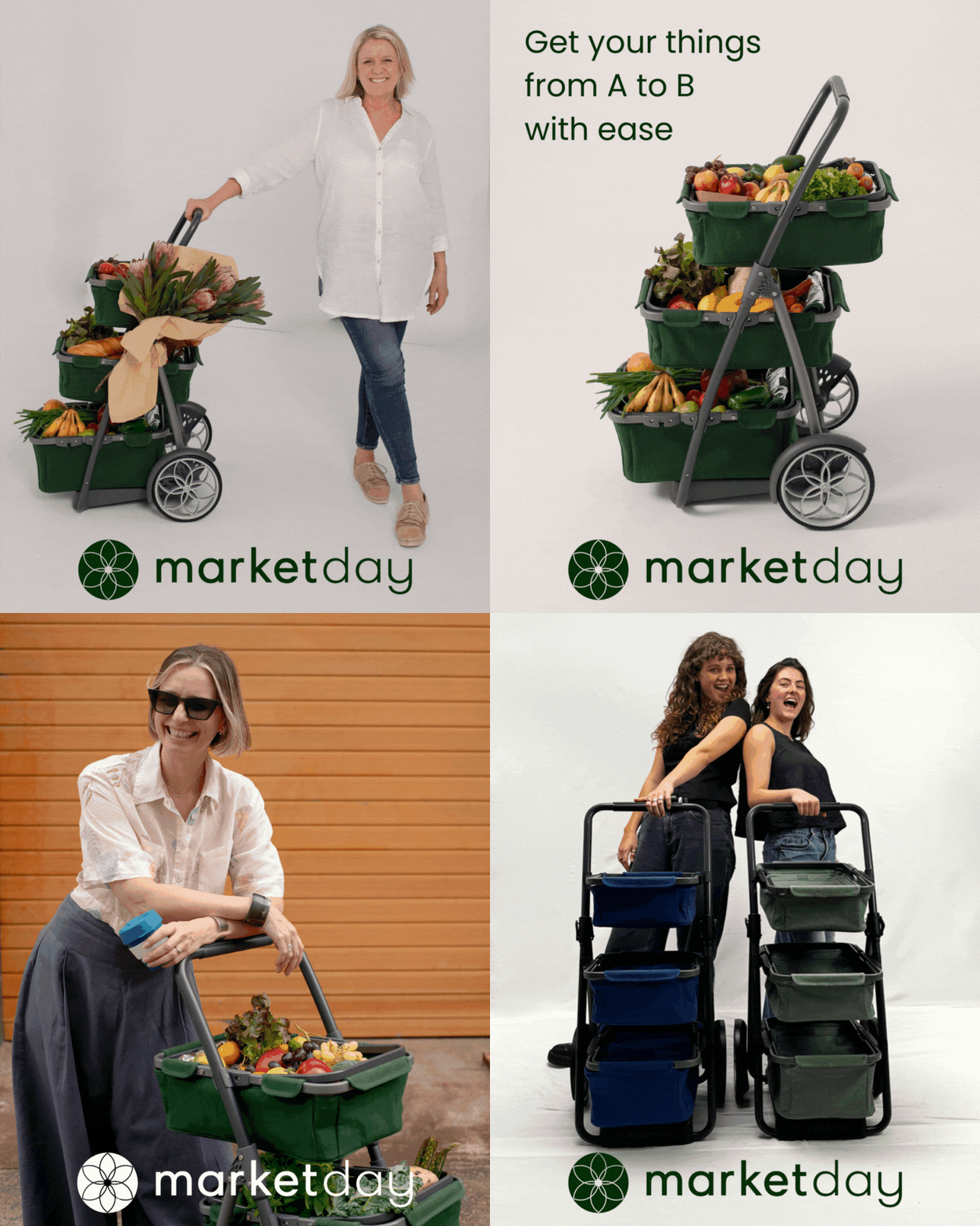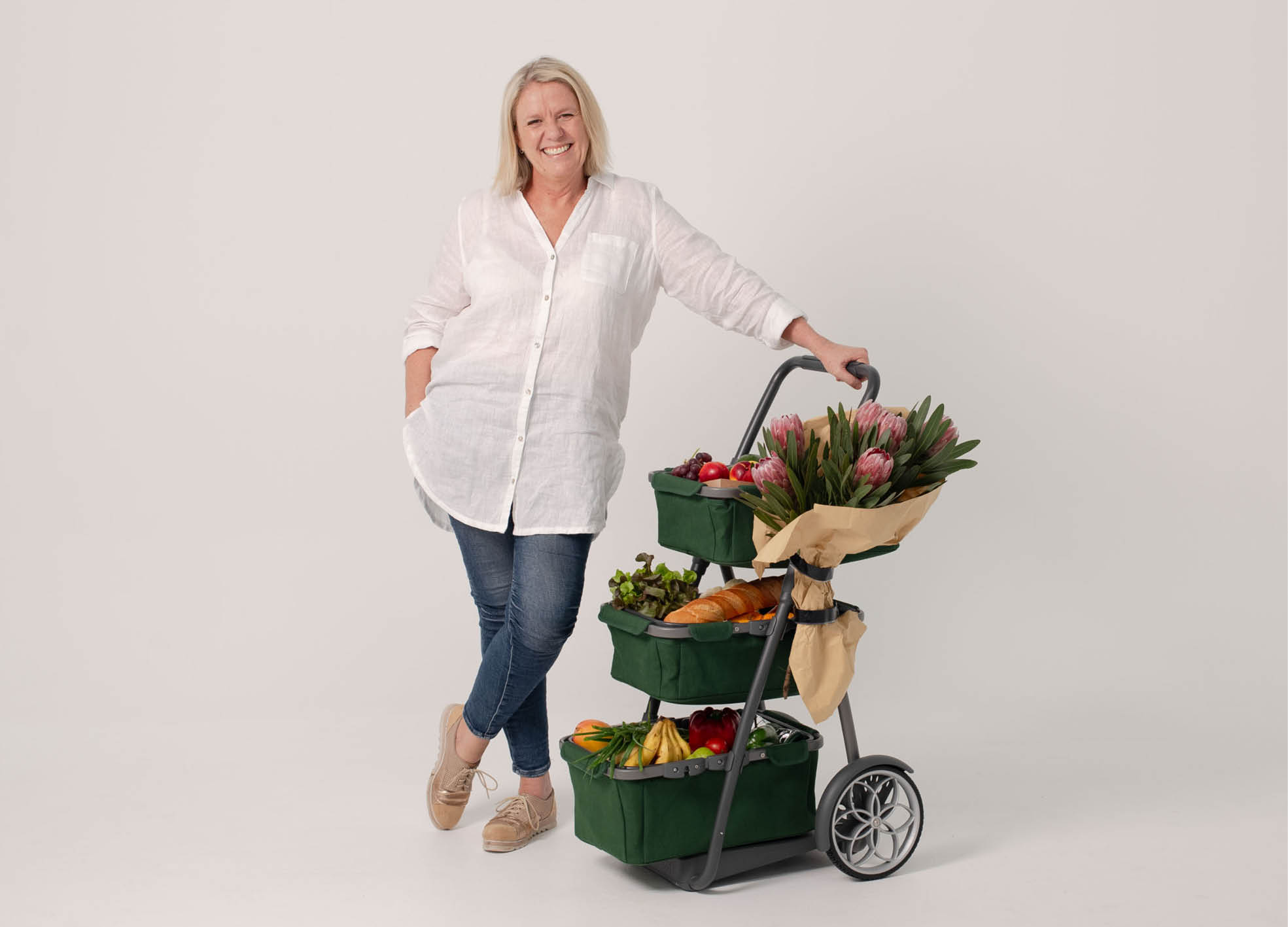
We all do it: fire up the car for a 5-minute drive to pick up groceries, drop off sewing supplies, or run a quick errand – trips we could absolutely walk, if only we had a practical way to haul our stuff. And nope, we’re not talking ‘granny trolleys’ with avo-squashing corners and wonky wheels that are basically bag-toppling cartastrophes waiting to happen! To solve exactly that problem, Michelle Hildebrand, founder of Brisbane-based Marketday, designed the Marketday Cart: an award-winning (Gold AND Best in Class at the 2025 Australian Good Design Awards) piece of functional design that’s found fans far beyond the farmers’ market crowd. The Marketday Cart’s sleek, sturdy design has made it the Swiss Army knife of getting around, not just for eco-conscious shoppers ferrying fresh produce home, but also for makers hauling their wares, families schlepping library hauls and picnic gear, and anyone who values walking over driving. It’s made to last a lifetime with replaceable parts and an aluminium frame – the antithesis of throwaway culture. We invited Michelle to share more about its many positives…
Hi Michelle! Something tells us there was an ‘Incident’ that sparked your journey creating The Cart… Can you tell us what happened?
We got the idea from our own dramas at our local Nundah Markets. We loved going because it doubled as a three-generation catch-up: my daughter and I meet my mother there every week. But the effort required to keep everything from being squashed or damaged was getting too much. It made the whole thing into a military operation. Also, we noticed that while people were coming to farmers markets, there still didn’t seem to be enough folks making the effort – because it really was an effort!
We wanted a better option, one which kept people coming and encouraged them to support local business – the little guy – over the big grocery duopoly. So, there were the practical solutions, but there were also the emotional attachments that we had formed at the markets. If you’ve ever been to the same shop or business regularly, you get to know the vendors. There was a lovely feeling of connection at the markets that drew us back every week. I started to think about my work at that time, which was in the community sector with not-for-profits. I knew that loneliness and isolation were our biggest killers. So, what if a better way to carry your stuff was part of the solution to get people out and about and in their communities? I imagined a woman in her late 60s, living alone just 100 metres from the markets – but she never comes because she struggles to carry stuff on her own, and isn’t confident that she could manage. I thought about the value she would get from regularly being at the markets. People would get to know her, and get this: they would ask where she’s been if she misses a week. They’ll notice. I think this is a simple but profound effect that connection – at all levels – can have on your life and sense of belonging.
I knew that loneliness and isolation were our biggest killers. So, what if a better way to carry your stuff was part of the solution to get people out and about and in their communities?
Many of us love our granny trolleys – but it’s true that they’re not always that reliable (or stylish). What makes the Marketday Cart different, what are some of its nifty features, and how can they benefit those who use them?
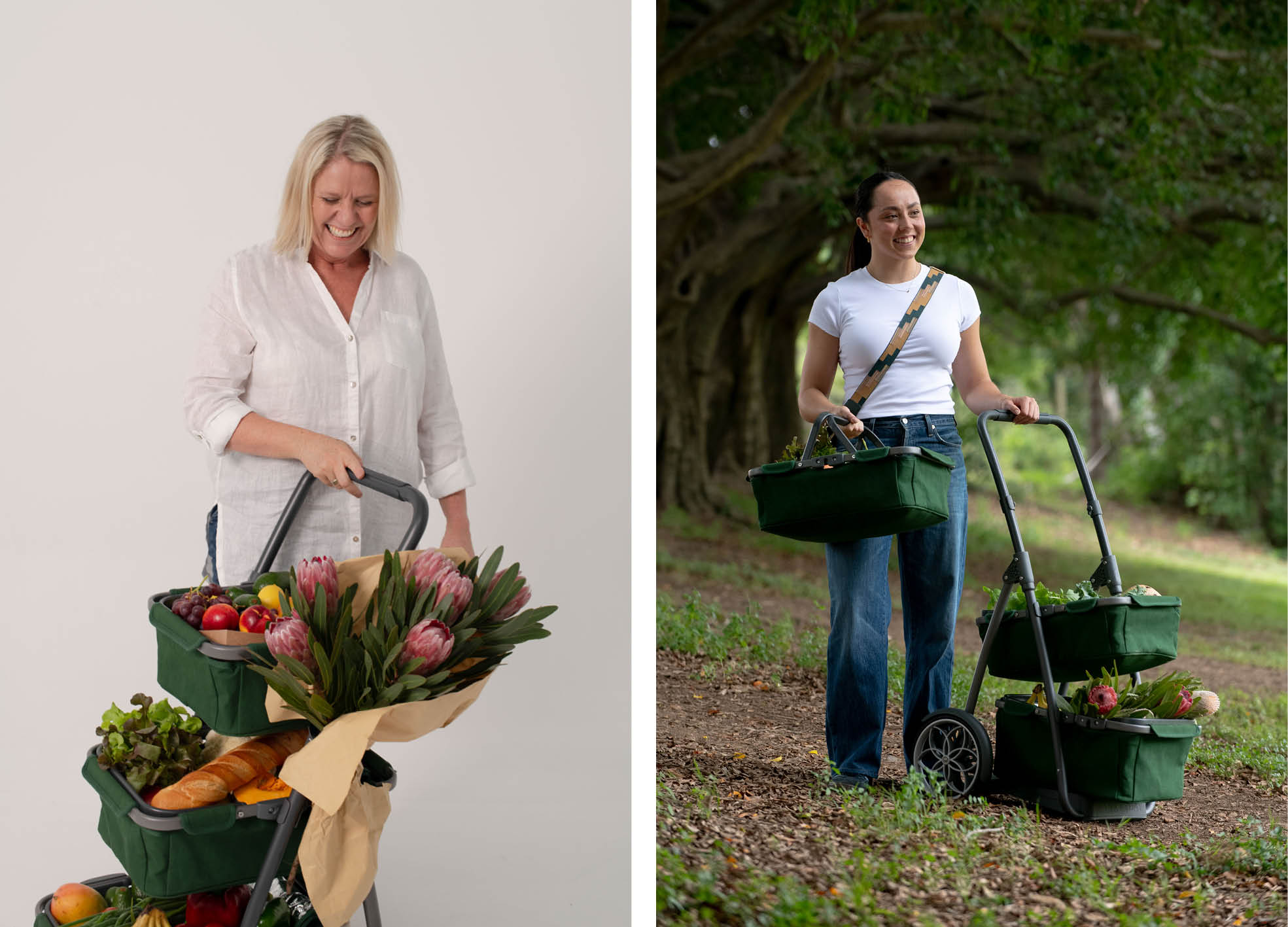
The cart is for people who like to organise and hate fossicking through deep bags looking for that thing they dropped in there just five minutes ago. The three levels give you full control over where your things go and how they play with their neighbours. You can actually put hard and soft things together when they are nicely nestled. The baskets are also fully insulated, fully zippered, and shallow enough that nothing gets crushed, but deep enough to make it worthwhile. The baskets can all be used separately – so it’s actually four bags in one – and you can use one, two, or three baskets on the frame at one time.
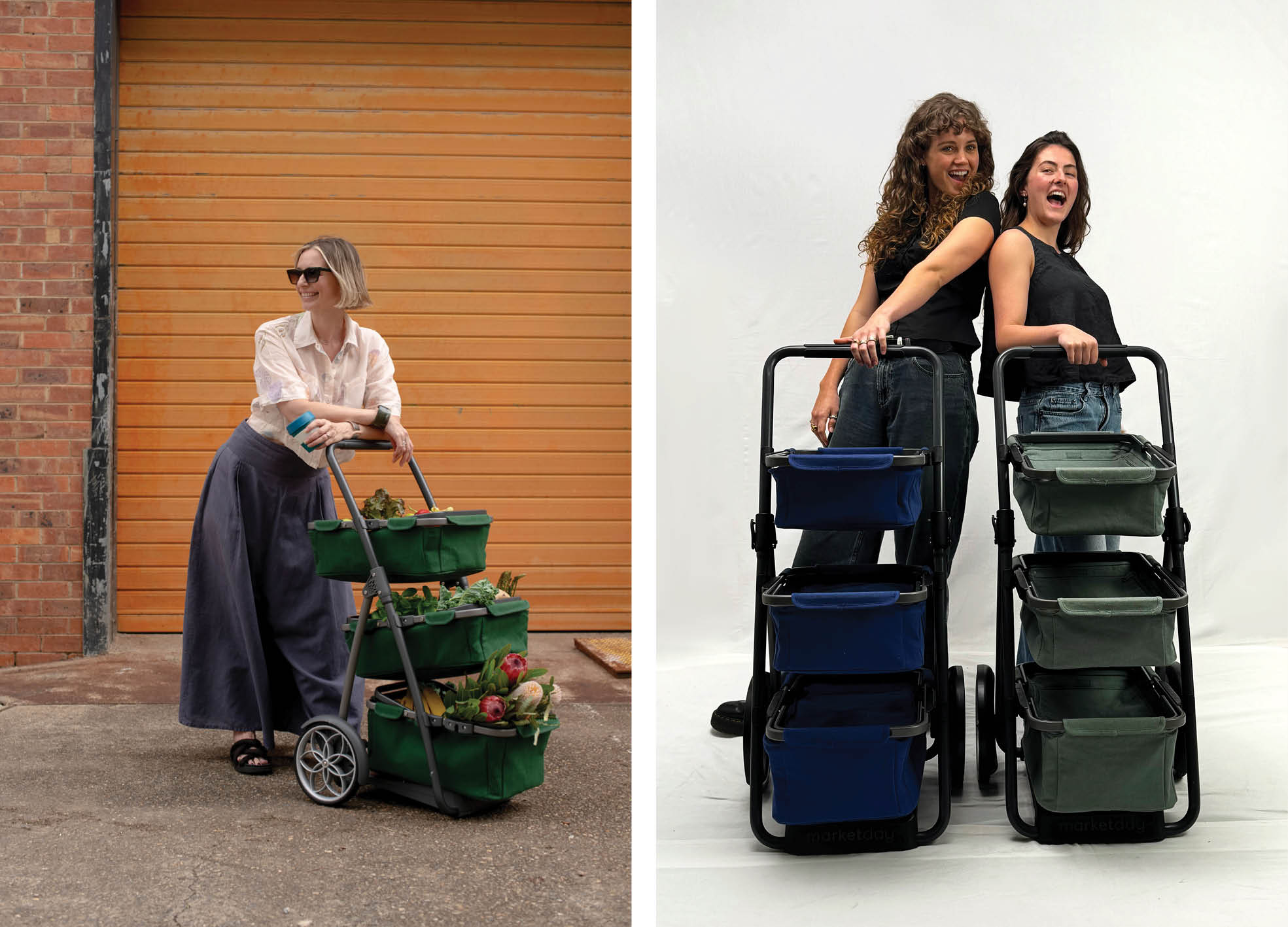
Big wheels take on curbs and stairs, and the whole cart folds to half its size for convenient storage. One of our favourite features is the gimbal that connects the baskets to the frame. It makes the baskets swing to a horizontal position when the cart is tilted and in motion, so your load doesn’t tip out. Overall, she is sleek in her design with a curved frame, low-maintenance wheels and three colours to choose from. Looking ahead, we want to bring out more colours and ultimately customise the basket fabrics.
How did you go about designing the Cart – were there specific solutions you were looking for, and where did you find inspiration?
We worked with Brisbane-based Industrial Designers Clandestine Design Group. We knew we wanted at least three levels to give us that control over separating items as we needed. But the big driver of the design and choice of materials was my kids. They loved the idea of me bringing the cart to life, but said that no matter what happens, it can’t end up in landfill. Driven by this need, we chose aluminium – it’s durable, and 80% of available aluminium is already recycled. Where needed, we’ve used recyclable plastics, and we’re looking to repurpose the fabrics until we can recycle them as well. The other problem we needed to solve involved items falling out of the baskets. Because they are shallow, when you tip them up, the contents go flying. My dad actually spotted the problem – when he saw the first prototype, he commented, “You’re gonna lose ya load, love!” So, we designed the gimbal to make sure that didn’t happen. The zipped lids help with insulation but also create another barrier to your stuff falling out of the cart. As with all product manufacturing, trial and error played a starring role with a couple of prototypes that taught us a lot about what we did and didn’t want.
On the note of inspiration – you mention Carlos Moreno’s work behind the concept of 15-minute cities – how did that inform the Marketday Cart?
Ah yes! 15-minute cities are popping up all over the world. Local governments are making bold moves to remove car parking and change the priority on the streets to pedestrians and cyclists. They are either redesigning what they have or building with 15-minute city principles in mind, which include shade, rest areas, water fountains, open space, better pavements and inclusive access around the city. I really do feel that the cart is a complement to these innovations in urban life because if you still don’t have a way to carry your stuff, all that design goes to waste. We’ll never lose our love of the tote bag, but a better wheeled cart could change the way we live and play in urban centres around the world. The other thing is that it’s often women in our culture who carry the everyday things. We carry for our kids, our families, our elderly parents. We multi-task every trip, which means we’re probably carrying lots. In terms of your physical health, this activity is great, but when you are pushed beyond your limits and start to carry things awkwardly or dangerously, you need to think about a better alternative. If you don’t have a better way, you start to be less engaged and less mobile or rely on the car much more.
It’s often women in our culture who carry the everyday things. We carry for our kids, our families, our elderly parents. We multi-task every trip.
You’re working to create a product that has ‘sustainability as its focus’ – can you tell us more about what you’re doing to hit your sustainability goals?
We are part of an international group called Coralus. This group is changing the way women and nonbinary people access capital to build not just businesses but create transformational change. Part of this is to commit to UN Sustainable Development Goals. We chose Goal #3: ‘Good Health & Wellbeing’, and Goal #11: ‘Sustainable Cities & Communities’.
The thing about sustainability is that it’s a journey. We are committed to doing what we can for each stage of our business. So, our contribution to sustainable cities and communities is in the physical product avoiding landfill and providing a way for communities to move around without a car. Good health and wellbeing are also a byproduct of being out and about in your local area – connection, belonging and being are all part of your personal contribution to a cohesive community. Good physical health is all about moving your body.
So, with a focus on the product, our first step was to make sure that the choice of materials made sense for sustainability: aluminium and plastics, which are recyclable. Our fabrics are cotton; not organic cotton, so we’re working towards a better option there as we scale and grow. However, we are using linen in our produce bags, which makes them very durable, lasting wash after wash and eventually returning to the earth to break down. They are also great for packing delicates in your suitcase – just sayin’!
Another thing we are looking at is reusability of the frame over and over. When you buy a cart, you could feasibly use it for decades, then pass it down to your children. The fabric liners are easily upgradable, and the cart components are replaceable. So, we can spruce up the cart if she has an accident or wears down in any places – or if the new owner has a different colour preference. But when you have no one to hand it to, I can’t bear the thought of someone putting it out for kerbside pickup! So, I’m also working towards a ‘gently used’ portal on the website so the cart can find a new home, and the cycle continues because she has more life to give.
Congrats on your Gold and Best in Class awards at the 2025 Australian Good Design Awards! Why are these kinds of awards meaningful, and how did it feel for your work to be acknowledged?
Gosh – this was an amazing moment for us. We knew we had something good and so we entered into the awards. The titles of Gold and Best in Class are wonderful and being able to use these logos add real credibility to our product. But the judging criteria is what makes me most proud. The best designers in Australia (who also usually hold a place on the world stage) made the decisions. They looked at Good Design, Design Innovation, and Design Impact. They asked questions like: does the design clearly communicate its purpose, enhance user experience, and respond to its environment? Does it show improvements in user well-being, environmental sustainability, or business performance? Is the product designed for longevity, repairability, and responsible production? When you get Best in Class for having the answers to these questions, it’s pretty mind-blowing, and you realise that someone else has really seen you and understands what you set out to do.
You’ve mentioned being part of Coralus, a global community of change-makers working on ways to make a transformational impact – can you tell us more about how this works?
Yes! Coralus is a 7000-strong network of women and nonbinary people working on access to capital for under-represented people (i.e. women) and how that capital can unlock transformational change. Women work in different ways to men, and there is real power in how these characteristics play out in the building and scaling of a business. It’s a model built on connection, relationship to others and a deep sense of what the world needs to repair itself environmentally and spiritually. It’s brought me into contact with some amazing women of all ages and stages of their life and business and has provided a space where I think Marketday can create real value beyond just sales.
And finally: what is the oddest or most unexpected thing you’ve ever hauled in one of the Marketday Carts?
My husband has put the cart through its paces. Overloading with tinned tomatoes and bags of ice, especially in the prototype phases!
We are only launching now so we aren’t really out in the world yet. So, we haven’t seen all the wild and wonderful things that people will haul. But I am hoping to see urban dwellers choosing the cart for all things local living, crafters getting their supplies organised, sewing machines off to sewing guild, books and quiches for book club, charcuterie boards and champagne to the local park. But equally, I’m excited about legal files heading into the courts, designers and makeup artists carrying the tools of their trade, small businesses carting their stock into a pop-up market, medical supplies moving across a tent city and water being provided for people waiting in long lines for services or support. I’m excited about the act of living being enhanced by an easy way to get your stuff from A to B.
This article was created in partnership with our friends at Marketday. To read more about Marketday and explore their range pop over to their website.