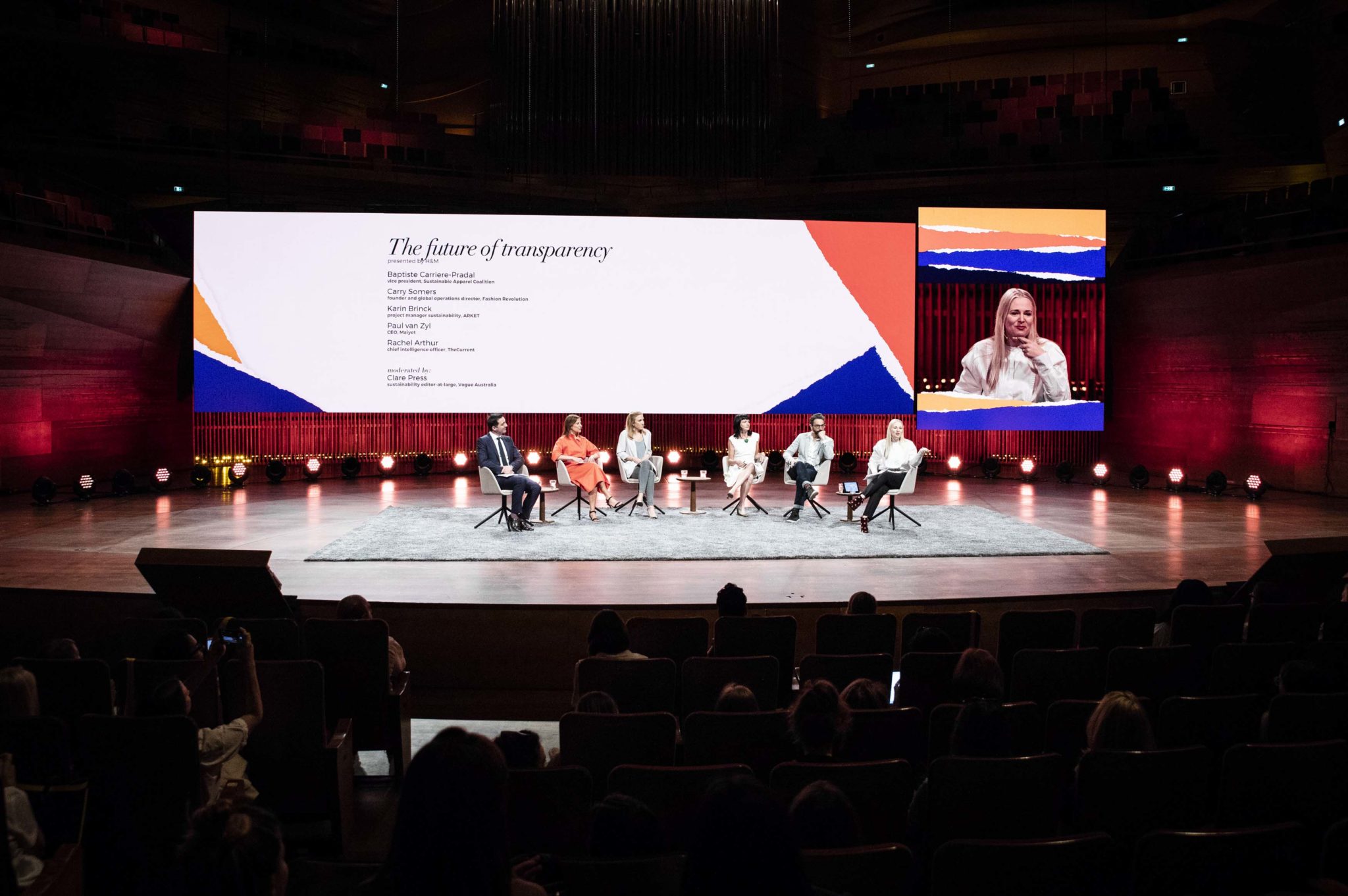
From Danish royalty to fashion royalty, every global player who cares about creating a positive fashion industry came together at the annual Copenhagen Fashion Summit. Since sustainable fashion is very much our love language, Peppermint was right in there – sending our Marketing and Partnerships Manager Roxane to get the lowdown on the key trends and plans for bringing real change across a massive industry. Here’s just a few of the gems she brought back:
- There’s no easy fix. The fashion industry is complex – it employs 60 million people around the globe and has multiple layers of supply chains. The Summit’s key report, ‘The Pulse of the Fashion Industry’ says, ‘Even under the most optimistic assumptions, the industry’s existing solutions and business models will not deliver the impact needed to transform the industry.’ Put simply, it ain’t simple to put things right in fashion.
- Think ‘next life’, not ‘end of life’. Bill McDonough – eco warrior and creator of the concept of ‘cradle to cradle’ design – challenged designers to design with an item’s next use in mind. Cheap fast-fashion is designed for a short life to encourage consumers to buy more – and sadly, it’s working. The Pulse Report predicts demand for clothing will increase at 2% per year, but at the same time the average item of clothing is worn only 10 times before being thrown out. In total, three-quarters of all used materials processed along the fashion value chain are lost in landfills. Less than 1% of all clothing materials are recycled into new garments. Paul Dillinger, Head of Global Product Innovation for Levi Strauss & Co said, ‘If six out of ten garments we produce end up in a landfill or incinerated within the first year of production, should we have made those six?’ Seems like a no-brainer to us.
- Sustainable fabrics are becoming better business. Industry experts are optimistic these alternative fabrics will become more attractive to fashion companies, as the prices of conventional cotton and polyester are expected to rise in line with the costs of their largest inputs – water and oil. Using organic cotton in place of regular cotton can save up to 90% of fresh water and 62% of energy, and using recycled polyester instead of making it from virgin fibre equates to a 90% reduction of toxic substances, a 60% reduction of energy usage and up to 40% of reduced CO2 emissions.
- Smart materials are a-coming! Gold jackets made from pineapple leather and ocean plastic-netting transformed into new textiles were just some of the nifty innovations on show at the Summit – along with our personal fave: plant-based, biodegradable glitter! Smart clothing, such as the self-heating parkas that Ralph Lauren made for Team USA at the 2018 Winter Olympics, were highlighted in the Pulse Report. Heating systems embedded in the parkas kept the athletes warm for up to 11 hours – cool, no? Researchers from Massachusetts Institute of Technology in Boston have created a system called ColorFab, which allows users to change the color of 3D printed objects even after they have been printed. Clothes made this way would allow us to refresh the look of our garments without needing to purchasing new ones. Hello, thriftiness!
- Collaboration, not competition. Keeping fashion moving towards a circular fashion economy is key to sustainability – and this involves all of us. ‘Collaboration, not competition’ was a common phrase at the conference – companies have a responsibility to give us options to dispose of the clothing we no longer want, and our responsibility is to make sure we decide on pretty much any option than throwing stuff in the bin. H&M have a longstanding, in-store collection program where old clothes and textiles are turned into new products, and new company The Renewal Workshop offers an innovative garment refurbishing program – taking unsellable garments from partner brands and sorting, cleaning and repairing them, before giving each garment new life. The garments are then on-sold through the original brand’s channels, or on The Renewal Workshop’s website. Presently based only in the USA, they are looking at expanding operations globally. Come hither, guys!

- Transparency has to be the norm. Brands build trust in their customers when they provide traceability and transparency in their supply chains. If your favourite brand won’t tell you who makes their clothes, demand they do –and if they won’t, then ask yourself (and them!) if this means they have something to hide.
- We need more leadership – and that starts with you! Many speakers called for more regulations around worker and environmental protection. The Californian legislature is considering a bill which, if passed, would require polyester clothing containing more than 50% polyester to carry a label saying the garment releases plastic microfibres when machine washed – and similar labelling laws are being discussed in the EU. Australia is expected to draft laws this year that mean companies must look into their supply chains and be sure they’re free from modern slavery practices, labour exploitation or debt bondage. Our role as consumers can involve lobbying our elected members of parliament to propose and pass protective legislation – we need to lead our leaders!
- No-one’s perfect. So true, right? Speakers at the summit were quick to acknowledge their failings, with even Stella McCartney saying her company isn’t perfect. However, one thing everyone agrees on is that doing something is better than nothing. We should never underestimate the power we hold to make a positive difference in the world – one ethically made decision at a time.
HUGE THANKS TO OUR FRIENDS AT EMIRATES AND AIRBNB FOR HELPING US ATTEND THE SUMMIT!