
words BRITTANIE DREGHORN photos UNSPLASH
Afterpay is having its day in the fashion industry, but are buy now, pay later services fuelling mindful or mindless purchases? Brittanie Dreghorn, of online ethical fashion blog Britt’s List, discovers more.
Love them or hate them, buy now, pay later (BNPL) services are certainly having a moment. It’s commonplace to see an Afterpay logo in the header of an e-commerce website, and it’s just as likely to be stacked next to a range of competing payment services, each offering a “better way to pay”.
Afterpay Day, offering shoppers huge discounts from thousands of brands both online and in-store, has become a popular bi-annual addition to the shopping calendar. The sale has quickly gained traction in Australia, even being taken up by brands that don’t offer the BNPL service.
This year, Afterpay was also the headline sponsor of Australian Fashion Week for the first time – a bold statement for both the payment service and the industry.
These BNPL services all claim to be committed to responsible spending, and position themselves as a fashionable alternative to debt. But to suggest their motives are purely altruistic would be a misstep. Afterpay’s stock has been on the rise since the company publicly listed in 2017 at approximately $3 a share. It’s now valued at almost $120 a share, at the time of writing, and has a market capitalisation of $34.49 billion.
But who else is benefitting from these increasingly popular payment services that are so heavily targeted at the fashion industry? Is fast finance fuelling fast fashion, or is it opening consumers up to a market they might otherwise not have been able to access – ethical, well-made clothes?
A boost for ethical fashion…
When surveying 21 ethical fashion brands in Australia, we found the majority (81%) said they offer deferred payment services.
Of those brands, 52.9% said their sales have increased as a result, and the overwhelming majority (70.6%) said the services were helpful in making ethical fashion accessible to a wider audience.
Citizen Wolf and Lois Hazel are two of the ethical fashion brands that have seen increases in their sales as a result of offering BNPL services.
Eric Phu, co-founder of Citizen Wolf, says that offering BNPL services like Afterpay and Zip is important because customers should have the choice to decide which payment service works best for them – even if it comes at a cost to his business.
Ethical and sustainable fashion means a higher quality product that hasn’t relied on exploitation or cutting corners to reduce and hide costs. The result is a higher price, which unfortunately does make it harder for people to do the right thing all the time.
“These payment services do cost us more than traditional options like credit cards,” he says, “but we absorb that cost rather than nickel-and-diming our customers. The far more important thing is to make our products as accessible as possible for customers to be able to choose options that are best for themselves and the planet.
“Ethical and sustainable fashion means a higher quality product that hasn’t relied on exploitation or cutting corners to reduce and hide costs. The result is a higher price, which unfortunately does make it harder for people to do the right thing all the time.”
Lois Hazel designer Lois McGruer-Fraser feels similarly towards the payment services. Her e-commerce store offers customers both Afterpay and Klarna as checkout options, among other traditional methods.
“I think it’s a great way to allow people to engage with ethical and sustainable brands that may be on the higher price point end of things,” Lois says.
“When it wasn’t available to our New Zealand customers, which has since been resolved, we did get a few enquiries asking when it would be available. We even worked with a few customers in setting up a payment plan outside of the website, almost like a lay-by situation where they made weekly instalments and, once paid off, we would ship out their new goodies.”
READ MORE: THE AUSSIE BRAND FIGHTING FAST FASHION TO TAILOR A BETTER WORLD
… But at what cost?
Rachel Driml, owner of ethical e-commerce boutique The Good Look Store, says that while she does offer deferred payment services on her site, she has some reservations about them due to their role in promoting “over-consumption” and creating unnecessary financial hardship.
“I do think we as businesses and business owners bear some responsibility here,” she says, “and it’s important to try to play our part in creating an ethics-focused shopping environment.”
Her way of creating this environment is to discourage big sales and instead offer non-trend-based, high-quality products, as well as educational content around sustainable consumption.
“It’s not easy as a small business – a big sale, or ‘buy buy buy’ focused marketing, is a great way to get some quick cash flow and reach a new customer base,” Rachel continues. “But it would go against every value of the store, so I don’t do it.”
Adelaide-based sustainable fashion designer Brianna Gaal is going even further, actively choosing not to offer BNPL services.
It gives more people access to fashion, which is a good thing, but I also think it has the potential to promote overconsumption and impulse purchases. It has been heavily marketed towards non-essential product categories, like fashion.
“At first it was not a conscious choice,” she says. “I planned to offer [deferred payment services], but when I looked into it, I became a bit suspicious.
“I think on the surface there are lots of benefits to BNPL. It gives more people access to [ethical] fashion, which is a good thing, but I also think it has the potential to promote overconsumption and impulse purchases. It has been heavily marketed towards non-essential product categories, like fashion.”
“As I’ve never offered these services, I don’t know what the exact impact of not offering them has been,” Brianna shares. “I may very well have missed out on sales because I don’t offer it. I’m not against it in the future, but I would just like to see more specific regulation and consumer protections put in place, as it has now become a huge part of the retail industry.”
One anonymous respondent to the survey said they believe BNPL services give buyers a false sense of financial security.
“These services encourage excess consumerism,” they said. “The only one who really benefits at the end of the chain is the retailer, at the expense of the customer and the environment.”
It’s worth noting, too, that the BNPL market has been relatively unregulated to this point. The requirements for using services such as Afterpay include an age limit and an active debit card, and that’s about it. But that looks to be changing, with the most obvious regulatory addition set to be credit checks on new users.
Is it worth it?
While we love to see that these services have led to an increase in spending on ethical fashion, it’s likely this trend is happening across all retailers in the industry, as fashion at both ends of the scale becomes more accessible on a regular basis.
And as Aussies, we don’t really need any more encouragement to consume fashion. According to the ABC’s War on Waste, as a nation, Australians spend around $5 billion a year on fashion – the average shopper spending $2,000 a year. We end up throwing a lot of these textiles away, with almost six tonnes of the stuff going to landfill every 10 minutes.
“I do notice that we get a higher percentage of returns from those who buy using Afterpay,” one survey respondent said.
Ultimately, of course, the blame for excessive consumerism can’t be laid at the feet of any one type of payment service – but it seems fair to be wary of any service that gives consumers one less reason to consider the impact of their purchases.



Between 2000 to 2015, global clothing production doubled... while the duration of garment use decreased by 36%.
We are throwing away clothing at a faster rate than ever before. How can we tackle this problem?
✨️ WEAR
Be an outfit repeater - wear your items of clothing as long as possible. Learn to style your garments in various ways. Loved clothing lasts.
✨️ SHARE
If you really need to move it along, share the love with friends - hold a clothing exchange night! Or organise a timeshare with a friend where you swap a few favourite pieces of fashion. If you really can`t find a new home for it, then donate to an op shop or charity.
✨️ CARE
The care of your clothing – washing, drying and ironing – can account for approx 30% of a garment`s total carbon footprint. Hand wash, line dry, wash in cold water, and only wash when necessary.
✨️ REPAIR
Mending – and making – slows down fast fashion buying habits. Repairing used to be common practice, until disposable fashion took over. Extending the life of clothing by just nine months can reduce carbon, water, and waste footprints by 20–30%. Fixing doesn`t need to just be utilitarian – get creative with visible mending!
*Fact from The United Nations Environment Programme
#PeppermintMagazine #WearShareCareRepair #SustainableFashion


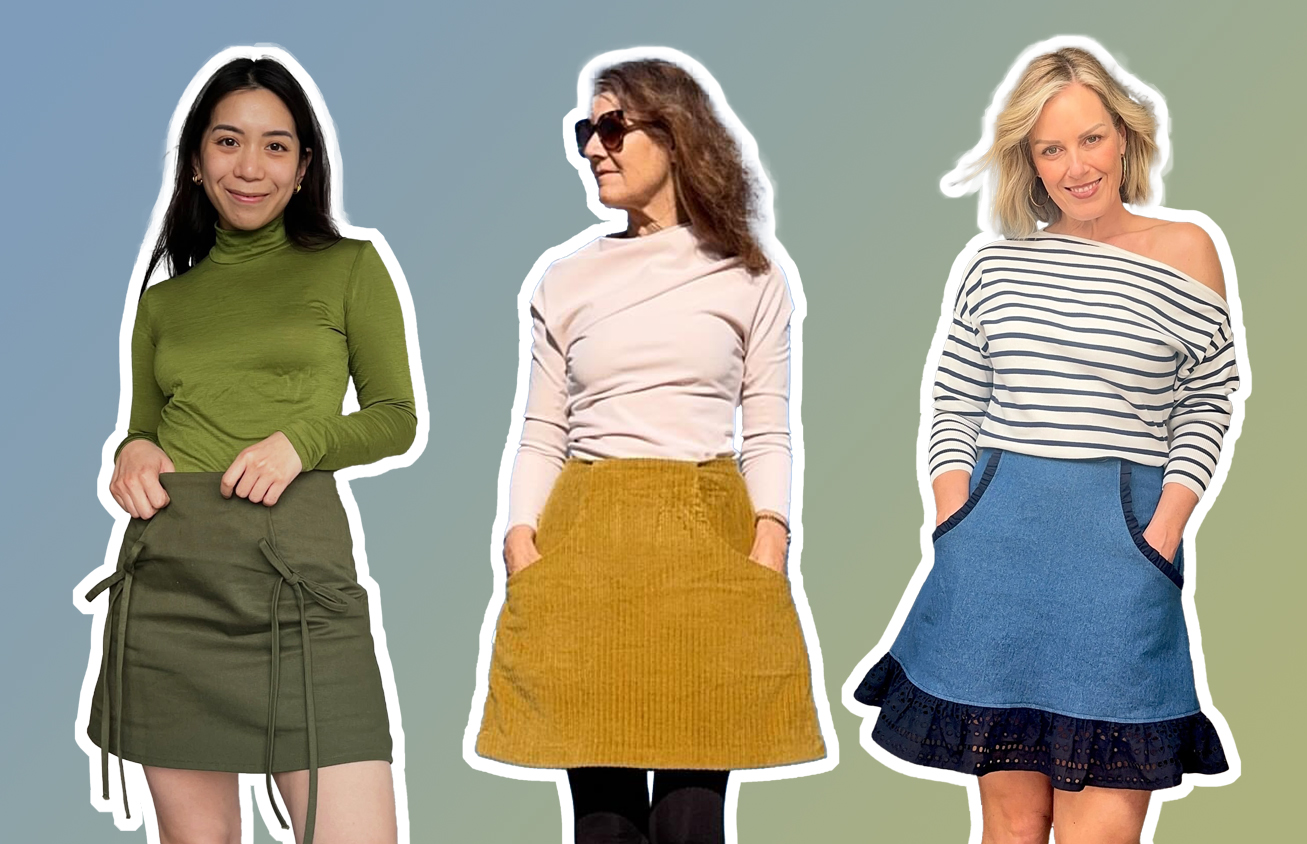
Have you whipped up the Acacia A-Line Skirt yet? 🪡
Accessible to beginner and experienced sewists alike, its classic style makes this skirt a wardrobe staple and a pattern you can happily play on repeat. Curved front pockets and the fun exposed-zip detail at the centre back make this style pop! The Acacia is a blank canvas, awaiting inspiration – add contrast top stitching, trim the pockets with bias binding or even change the length. We’ve chosen the smooth, clean lines that come from facing the waist, with back darts to ensure a neat fit on the hip. *chef’s kiss*
This pattern was made with the support of the lovely folk at @WeftAndWarpFabrics 🫶🏼 The team at Weft and Warp graciously sent three sewists the fabric of their choice to whip up their own Acacia A-Line – the results are super sweet!
Head to our website to see the makes from @The.Sewcialite @HandmadeByCarolyn and @You_CanSew - link in bio!
#PeppermintAcaciaAlineSkirt #PeppermintPatterns #WeftAndWarpFabrics #MeMade

Polka dots for days…
We love this Tansey Top by @_Rubys_Threads_ - the ultimate simple but stylish top you need in your rotation now!
Pattern: #PeppermintTanseyTop
Fabric: Japanese cotton @RawFibre
#MeMade #PeppermintPatterns

How`s your long weekend going? Working hard on your PhD? 🪡✂️🧵
Image from JoellsLeatherWorks on @Etsy
#ProjectsHalfDone #SewingPile #ProjectPile

In case no-one has told you lately, Emma Giacalone says you`re a good egg. (And we happen to agree).
This incredible mini egg embroidered 3D artwork was created by @Emma_Giacalone_Textiles, a textile artist in Gloucestershire, UK.
"When we buy an item of clothing, a label is attached telling us how to look after it to keep it at its very best. My mission is to create little care instructions to help to remind us to lead our happiest life."
INGREDIENTS: Freehand machine embroidered onto 100% cotton, using Egyptian cotton thread, and wool felt backing.
#EasterArt #GoodEgg #TextileArt

No ordinary wrap dress! 💃
Wrap dress wardrobe malfunction? Not with the Peppermint Waratah Wrap Dress pattern! We designed the Waratah to make sure this never happens.
Enjoy a few BTS videos from this super fun shoot. Maybe some inspo for Easter weekend sewing?
MODELS/SEWISTS: @Melt.Stitches, @KatieMakesADress @Tricky.Pockets @Laura_The_Maker
Head to the link in bio for the #PeppermintWaratahWrapDress 🪡
#PeppermintPatterns #SewingPattern #MeMade #WrapDress
